

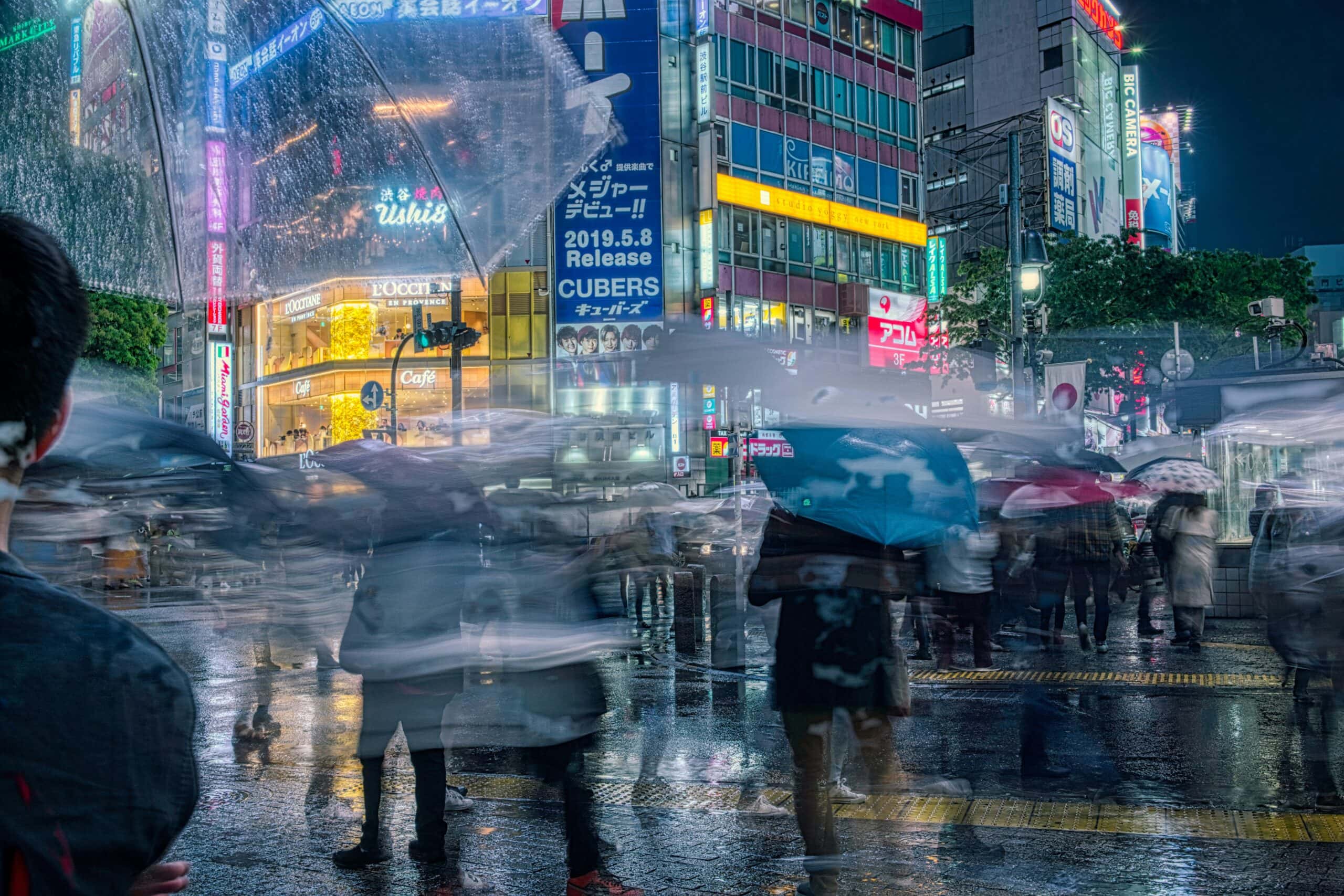
Day Trips from Tokyo in the Rain
Rain does not ruin a day trip. A fixed itinerary does. What a private guide brings to a wet day is not an umbrella; it is a completely different way of reading the day.
Day trips from Tokyo in the rain work better than most visitors expect. Rain is part of the Japanese calendar: it arrives in early June and settles in for weeks during tsuyu, the rainy season, then reappears in autumn with more force. Most visitors encounter it at least once, and many encounter it on the precise day they had planned to walk through an open-air temple complex or climb a mountain path.
A fixed itinerary treats rain as an obstacle. A private guide, by contrast, treats it as information. The question is not what to salvage from a ruined plan; it is how to use the day that is actually in front of you. This is the clearest argument for travelling with someone who knows the region: not that they prevent bad weather, but that they have already thought about it.
The day trips described here all work in the rain. Some are better for it. What changes with a private guide is not the destination; it is the quality of the decisions made along the way.


What Rain Actually Changes on a Day Trip from Tokyo
Rain in Japan is not the same as rain everywhere else. The country is built for it. Covered shopping arcades run the length of most town centres. Temples have deep overhanging eaves that shelter visitors from all but the most horizontal downpours. Shrines have stone paths that look better wet, the moss saturated and the gravel darkened to a deeper grey. The country does not shut down in rain; it shifts register.
What changes is the sequence of a day. Outdoor panoramas become less useful when clouds sit low on the mountains. Open-air markets run shorter hours. The approach to a site that is pleasant in sun can become uncomfortable in sustained rain without knowing which route has covered sections. These are not dramas; they are the ordinary texture of a day in Japan during wet weather. The problem arises only when a rigid schedule cannot absorb them.
The problem with fixed itineraries in the rain
A self-guided day trip to Kamakura planned around the Daibutsu Hiking Trail, the Great Buddha and the coastal path works beautifully in dry weather. In heavy rain, however, it becomes a sequence of uncomfortable compromises: the trail is slippery, the outdoor views are obscured, and moving between sites without a car means waiting on exposed platforms.
The same day with a guide is different. The hiking trail becomes an indoor craft workshop or a covered temple complex. The sequence shifts so that outdoor elements are attempted in the morning, when rain often lightens, and sheltered options fill the afternoon. The car is ready when needed, rather than a taxi app and a wet wait.
A private guide does not just adapt to rain. They have already planned for it before the morning begins.
What flexibility looks like in practice
Flexibility is not improvisation. A good guide is not making up alternatives on the spot; they carry a set of possibilities for every site and every condition, refined over years of doing the same routes in different weather. When they suggest moving the schedule by two hours or substituting one destination for another, it is because they have seen the same choice produce better results many times. That kind of local expertise is something no app or guidebook can replicate.

Three Day Trips from Tokyo That Work in the Rain
Nikko: better in mist than in sunshine
Nikko is two hours north of Tokyo by train and sits in a cedar forest that has grown around one of Japan’s most elaborately decorated shrine complexes. In dry weather the cedar avenues and stone lanterns are beautiful. In rain or mist, they become something else entirely: the forest grows quieter, the colours deepen, and incense smoke moves differently through damp air. Nikko may be one of the few day-trip destinations that is actively better in soft rain than in bright sunshine.
The shrines have covered corridors, sheltered courtyards and buildings large enough to explore without prolonged exposure to the weather. A guide who knows the site can sequence the visit so that the most exposed walks coincide with lighter moments and the detailed indoor spaces fill the heavier parts of the day. Additionally, the town has several small onsen that work well as a late-afternoon stop after a wet morning on foot.
Kamakura: edited by rain, not ruined by it
Kamakura is an hour south of Tokyo, set between wooded hills and the Pacific coast. Its Great Buddha is outdoors and photogenic in almost any weather; the bronze darkens beautifully in rain and the crowds thin noticeably. The temple at Hasedera has a covered viewing corridor and an underground cave system. Engakuji, just outside Kamakura station, has an inner temple garden that holds up well in wet weather.
The town has a covered shopping street near the station selling local crafts and sweets. A guide with a car can move between the temple districts and the town without exposing you to sustained rain between stops, and can make the call on whether the coastal walk is viable or better saved for another day. Kamakura is not diminished by rain; it is edited by it, with the most durable elements remaining strong and the peripheral ones simply dropped from the day.
Hakone: where rain and an onsen are not in conflict
Hakone is built around hot springs, ryokan and views of Mount Fuji. The views depend heavily on clear weather; Fuji is invisible perhaps half the days you might visit. In rain, the mountain disappears entirely and the Hakone Open-Air Museum becomes less comfortable to explore. This sounds like a strike against Hakone in wet weather. It is not, because the reason most people go to Hakone, even if they do not name it this way, is for the experience of an onsen.
Rain and a hot spring bath are, if anything, complementary. A ryokan with a rotenburo (outdoor bath) in light rain is one of the more specific pleasures Japan offers: warm water, cool air, steam rising into grey sky. A guide can build a Hakone day that does not depend on the weather for its central satisfaction, treating the museum and the lake and the ropeway as optional additions rather than the main event.


Covered Japan: Places That Reward a Rainy Day Trip from Tokyo
Japan has a category of place that dry-weather itineraries often overlook: the covered arcade, the market hall, the indoor craft workshop, the depachika (department store basement food hall). These are not substitutes for outdoor Japan. They are a different version of it, and they are frequently less crowded precisely because most visitors are queuing for the obvious outdoor sites.
The shotengai and the museum
A private guide who knows a neighbourhood can lead you into a covered shotengai (shopping arcade) not as a rain shelter but as a destination: a place where local shops have traded for decades, where a particular rice cracker, knife or lacquerware workshop is worth thirty minutes of unhurried looking. The rain outside becomes irrelevant because the place you are in has its own internal rhythm.
The same logic applies to museums. Japan’s public museums are well-funded, often architecturally interesting, and rarely overcrowded. The Tokyo National Museum in Ueno, the 21_21 Design Sight in Roppongi, the Nezu Museum in Aoyama, the MOA Museum in Atami: none of these are consolation prizes for a wet day. They are places worth visiting on their own terms, and a guide who curates the visit makes the difference between a dutiful walkthrough and something that stays with you.
A day trip that works in any weather
Haven Japan’s guides plan for the day you actually get, not the one on the forecast. Whether the sky is clear or not, the day is built to be worth the journey.
Book my private tourFrequently Asked Questions
Which Tokyo day trip destinations are best in the rain?
Nikko and Kamakura both hold up well in wet weather. Nikko’s cedar forests and shrines gain a particular atmosphere in the mist, and its covered corridors provide natural shelter. Kamakura has indoor temple halls, a sheltered hasedera garden path, and the town’s covered shopping street near the station. Hakone is more dependent on clear weather for the mountain views, but its hot spring baths make it a genuine rain destination in its own right. The right choice depends on your itinerary and what you have not yet seen.
Can a private guide really change plans on the day?
Yes, and this is one of the clearest advantages of travelling with a guide rather than following a fixed itinerary. A guide who knows the region well has a mental map of which sites close early in bad weather, which indoor options are within reach of where you are, and which detour is worth taking because the timing happens to be right. Flexibility is built into the day from the start, not retrofitted when conditions change.
What do you do when it rains hard on a day trip?
It depends on where you are. Heavy rain near Nikko or Kamakura means sheltering in covered temple corridors, rescheduling outdoor sections for later in the day when the weather often lifts, or moving to an indoor alternative such as a local craft workshop, an onsen, or a museum. A good guide anticipates this and builds the day with enough flexibility that a change of sequence or destination does not feel like a setback.
Is rain common in Tokyo and when is it worst?
Rain is part of the Japanese calendar in a way that rewards preparation rather than avoidance. The rainy season (tsuyu) runs roughly from early June to mid-July and brings persistent grey days with occasional heavier downpours. Autumn brings shorter but intense typhoon-related rainfall in September and October. Spring and winter are generally drier, though spring showers are common. None of these periods are a reason to avoid Japan; they are a reason to travel with someone who knows how to use the day well regardless of conditions.


